

CEILING OPTIONS & REPAIRS IN GOA
PVC Panel Ceiling Installation: Low-Maintenance Ceiling Solutions for Damp Homes Near Goa's Field Belts
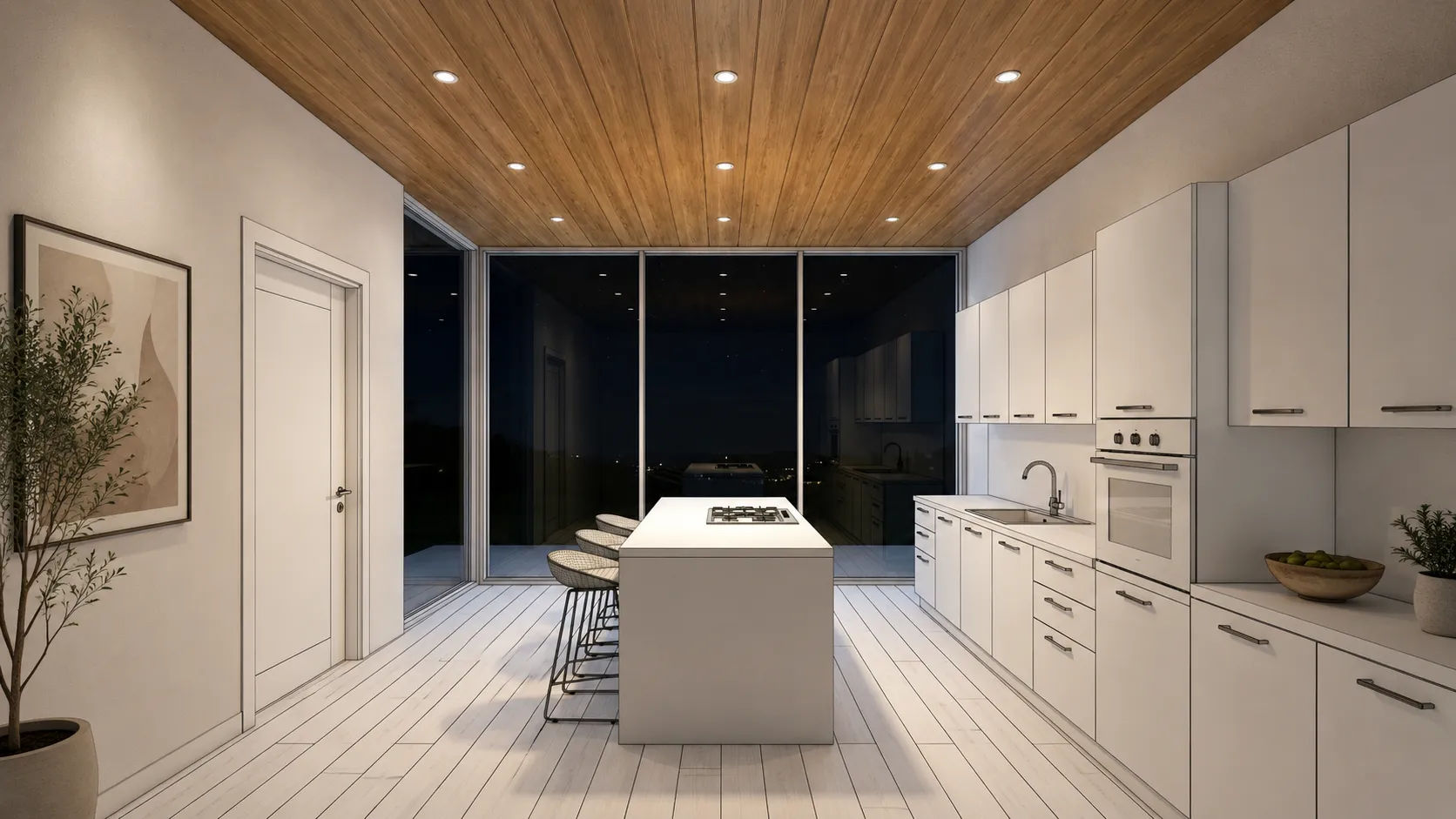
A number of North Goa's most sought-after residential pockets — Saligao, Sangolda, Assagao, Parra, and Moira— share something in common beyond their popularity: they all sit close to open paddy fields and low-lying agricultural land. It's part of what makes these areas so green and peaceful, and it's also part of why homes here fight a specific kind of dampness that drier, more built-up parts of Goa don't deal with as badly. If you've noticed a musty smell in a back room, a ceiling corner that never quite looks dry even in December, or paint that keeps bubbling no matter how many times you repaint it, the nearby field land and the moisture it holds is very likely part of the reason.
This is one of the most common calls Ceiling Squad gets from this field-adjacent belt across Goa — and it's worth understanding why it happens before jumping straight to a fix.
Why dampness lingers here specifically
Fields and low-lying land hold groundwater close to the surface for much longer after the monsoon ends than built-up, well-drained plots do. That moisture doesn't just sit in the soil — it rises through capillary action into adjoining structures, especially older homes without a proper damp-proof course in the foundation, which describes a lot of the Indo-Portuguese housing stock in this belt.
But soil moisture is only half the problem. The bigger issue is what happens to that moisture once it's inside a room with poor airflow.Humid air doesn't just evaporate away in a closed, low-ventilation space — it condenses on the coolest surface in the room, which is very often the ceiling, especially where a slab sits below a roof void or where an older tiled roof has minimal insulation. A room that's kept shut for most of the day, or has small, infrequently opened windows — common in older Portuguese-era layouts designed for shade rather than cross-ventilation — becomes a trap where that moisture has nowhere to go. It sits, it seeps into porous ceiling material, and over time it shows up as staining, peeling paint, or a persistent musty smell that no amount of air-freshener actually fixes.
This is exactly the situation where the ceiling material you choose matters more than in a typical inland Goa home.
Why PVC panels specifically make sense here
We covered the broader gypsum-vs-PVC-vs-Hilux comparison in our false ceiling humidity guide — worth a read if you want the full material breakdown. For a field-adjacent, high-dampness property like the ones common across Saligao, Sangolda, Assagao, Parra, and Moira, PVC panels tend to be the most practical starting point, for a few concrete reasons:
They don't absorb moisture the way gypsum or wood-based boards do.PVC is a closed, non-porous material. Where gypsum board slowly takes on ambient humidity and eventually sags or stains, a PVC panel simply doesn't have the material structure to absorb water the same way — it sheds moisture on the surface rather than pulling it in.
They don't support mould growth on the panel itself.Persistent dampness in a poorly ventilated room is exactly the environment mould needs. Paper-faced gypsum gives mould something to grow on; PVC's plastic surface doesn't offer the same foothold, which matters a lot in a back bedroom or store room that doesn't get opened daily.
They're genuinely low-maintenance once installed.No repainting cycle, no re-skimming, no chasing hairline cracks that widen every monsoon. A wipe-down is usually all a PVC ceiling needs, which matters if the room in question is one you don't want to be doing repair work in every year or two.
They're cost-effective relative to repeated gypsum repairs.Gypsum isn't necessarily more expensive to install initially, but in a genuinely damp room, you're often looking at repeat repainting or partial board replacement every monsoon or two. PVC's upfront cost tends to be recovered quickly once you account for what a damp room would otherwise cost you in repairs over a few years.
What this looks like for different home types
This isn't a problem specific to one kind of property — it shows up differently depending on what you're living in.
Indo-Portuguese homes: These are often the properties dealing with the most dampness, given older foundations, thicker walls that trap humidity differently than modern construction, and roof structures with more void space above the ceiling. PVC panels can be installed as a full ceiling replacement in problem rooms, or as a partial retrofit in specific areas — kitchens, back rooms, and bathrooms — while keeping gypsum or a decorative finish in main living spaces where the humidity risk is lower.
Flats and apartments:Dampness in flats across this belt tends to show up differently — often through a single problem room (usually a kitchen, utility area, or a bedroom with a shared wall to a damp-prone neighbouring unit) rather than the whole property. PVC panels work well here as a targeted fix for that one room without needing to redo the entire flat's ceiling.
Bungalows and villas: Newer bungalow construction in these areas usually has better damp-proofing than older heritage homes, but proximity to fields still means specific rooms — especially ground-floor rooms closer to garden or field-facing walls — are worth treating with PVC from the start rather than waiting for a dampness problem to appear.
In all three cases, the principle is the same: identify which specific rooms have the ventilation and moisture profile that puts them at risk, and use PVC there rather than assuming the whole home needs the same treatment.
Fixing ventilation alongside the ceiling — not instead of it
One thing worth being direct about: a PVC ceiling manages moisture better than gypsum, but it doesn't replace fixing the actual ventilation problem if a room genuinely has none. If a space has no exhaust and minimal window opening, trapped humidity will still affect the room's air quality and other surfaces even with a moisture-resistant ceiling overhead. Where possible, we recommend pairing a PVC ceiling install with a basic ventilation fix — an exhaust fan, or simply making sure existing windows are actually being opened daily — so the ceiling isn't doing all the work on its own.
What PVC panel installation typically involves
A standard PVC ceiling installation follows a similar structural approach to gypsum — a GI channel framework is fixed to the existing slab or roof structure, with PVC panels clipped into place rather than screwed and jointed the way gypsum board is. This actually works in your favour for damp properties: individual panels can be removed and replaced if one section is ever affected by an unexpected leak, without having to redo the entire ceiling the way a gypsum patch repair usually requires.
Dealing with a persistently damp room in Saligao, Sangolda, Assagao, Parra, Moira, or anywhere else near Goa's field belts? Ceiling Squad handles PVC, Hilux, and gypsum ceiling installation across North and South Goa, with material recommendations based on the actual moisture profile of your specific room, not a one-size-fits-all quote. Book a free site inspection with our false ceiling contractors in Goa →
Not sure which ceiling material fits your home? Read our full false ceiling humidity guide (Gypsum vs PVC)for a complete breakdown of gypsum, PVC, Hilux, and grid panel options across Goa's climate zones.